2026-05-06
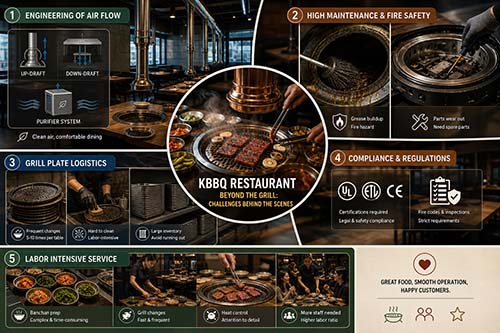
Opening a Korean BBQ (KBBQ) restaurant really does feel exciting at the beginning. The sound of sizzling meat, the smell of grilled food, people laughing around the table—it’s a great dining experience.
But behind this lively scene, there are some challenges that many people don’t notice at first. If you understand them early, you’ll save yourself a lot of stress later.
In a KBBQ restaurant, every table is like a small cooking station. That also means one thing—smoke is everywhere.
So the real challenge is not just grilling, but how to keep the air clean and comfortable for everyone.
Traditionally, there are two systems:
But in real operation, many restaurants now also use an important helper: a smoke purifier system.
A good smoke purifier can make a big difference.
It helps to:
In simple words, whether your system is top suction or bottom suction, adding a purifier makes everything easier and cleaner.
And one more important detail:
If the air system is not balanced properly, the restaurant can feel uncomfortable—sometimes even the door becomes hard to open because of air pressure changes.
So in KBBQ, air flow is not just a technical issue. It’s part of the dining experience.
With KBBQ, oil and heat are everywhere.
Grease doesn’t just stay on the grill—it travels into the pipes and ducts. Over time, it builds up, and that’s where the real risk begins.
If not cleaned properly, it can become a fire hazard.
So cleaning here is not just about being tidy—it’s about keeping your restaurant safe.
Also, grills work hard every day. Parts wear out faster than you think.
If one table stops working during peak hours, that’s not just a small problem—it’s lost business.
Having spare parts ready is not optional, it’s necessary.
This one surprises many new owners.
In a regular restaurant, one plate is used once.
In KBBQ, one table may change grill plates again and again—sometimes 5 to 10 times in one meal.
Why? Because burnt residue affects the taste of fresh meat.
But this creates new pressure:
If you run out during a busy night, service slows down immediately.
If you’re importing equipment, this part becomes critical.
In markets like the US or Europe, certifications like UL, ETL, or CE are not just “nice to have”—they are required.
Without them:
And because customers are cooking at the table, fire inspectors will look at your restaurant more carefully than usual.
It sounds like customers do the cooking, so maybe less work for staff?
In reality, it’s the opposite.
KBBQ service is very hands-on:
Good service here means being attentive without interrupting the dining experience.
That usually means more staff per table, not less.
KBBQ is not just about good food—it’s about experience.
When everything runs smoothly, customers don’t notice the system behind it. They just enjoy the moment.
But as an owner, you are the one making all of that possible—
from clean air, to safe equipment, to smooth service.
It’s not easy, but when done right, it’s incredibly rewarding.

If you’re looking for hot pot and BBQ equipment for your restaurant, then you’ve come to the right place. We have over several years of professional experience in hot pot induction cooker and BBQ grill technicians and our products obtained many national patents at present.
5F,Block16,Phase3,Tianfulai International Industrial City,Ronggui Town,Foshan City, Guangdong,CHINA.
Tel :
+86 13380500833Email :
gl.zhang@cenhot.comPlease read on, stay posted, subscribe, and we welcome you to tell us what you think.



Copyright © 2015-2026 Cenhot Catering Development Co.,Ltd..All Rights Reserved.



 gl.zhang@cenhot.com